Advertising display: Digital advertising exactly where purchasing decisions are made
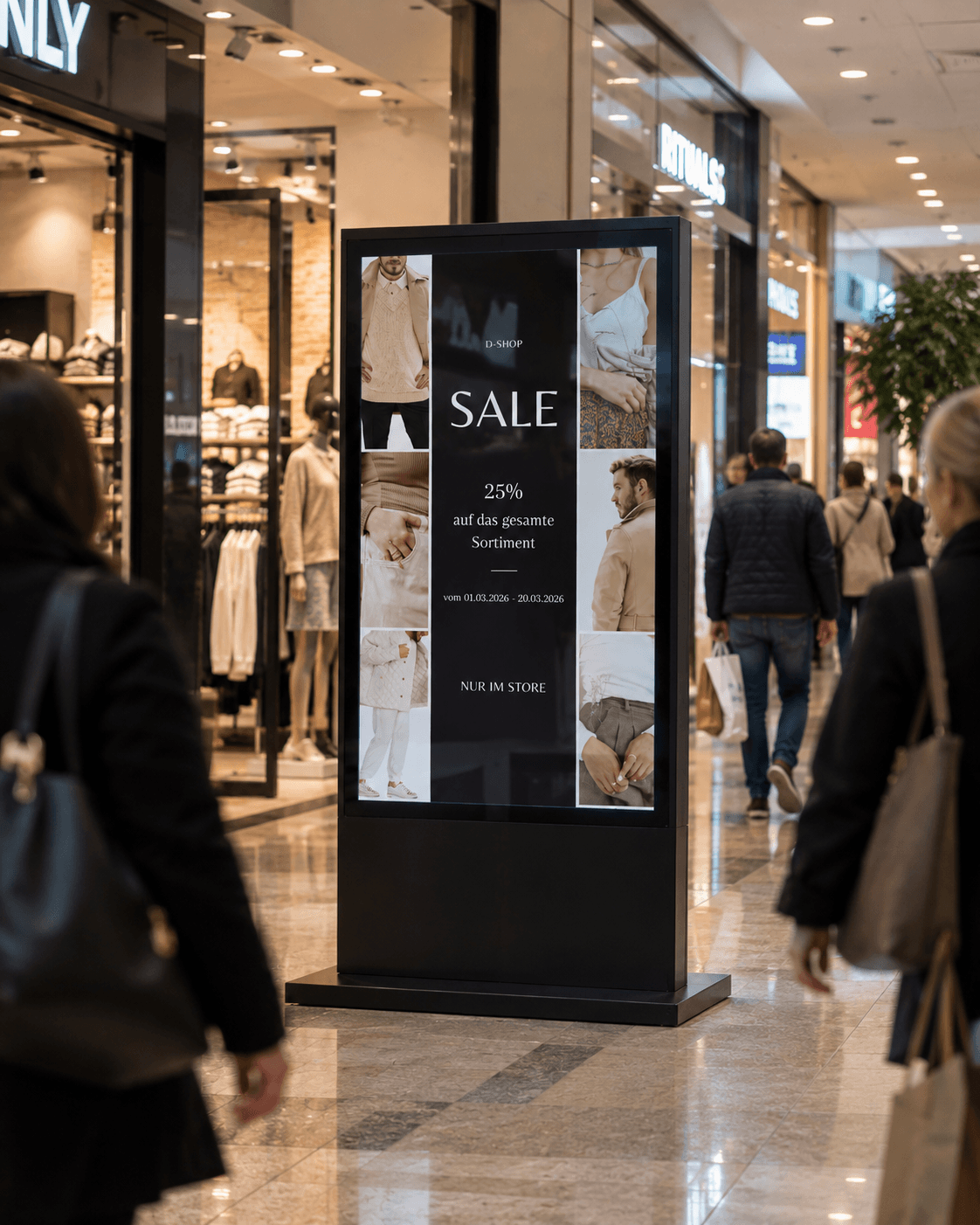
In brick-and-mortar retail, visibility is everything. Customers make many purchasing decisions directly at the point of sale—the very place where products are seen, compared, and chosen on impulse.
Being visible at this critical moment increases the chances of capturing attention, triggering impulse buys, and driving additional sales.
This is exactly where an advertising display comes in.
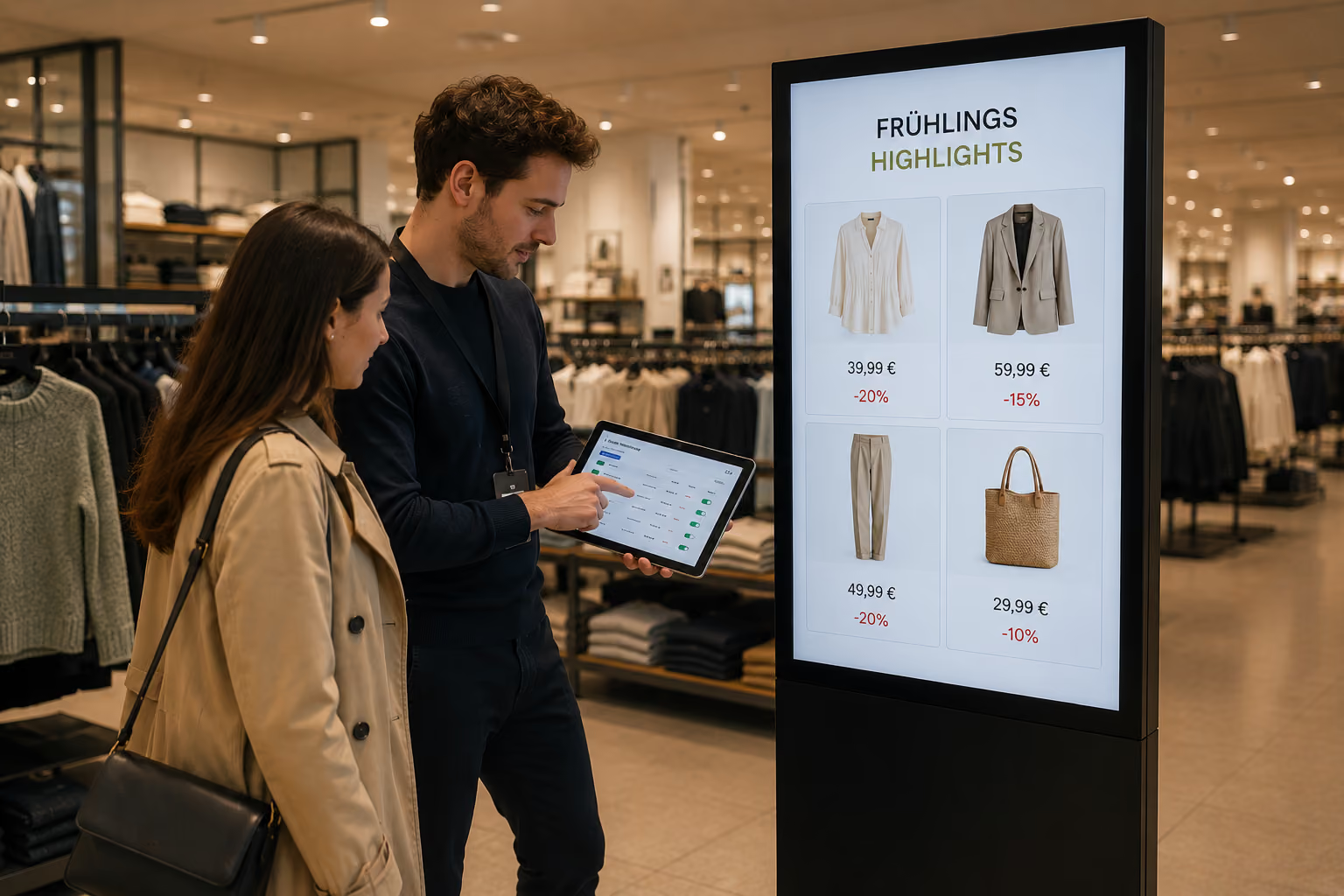
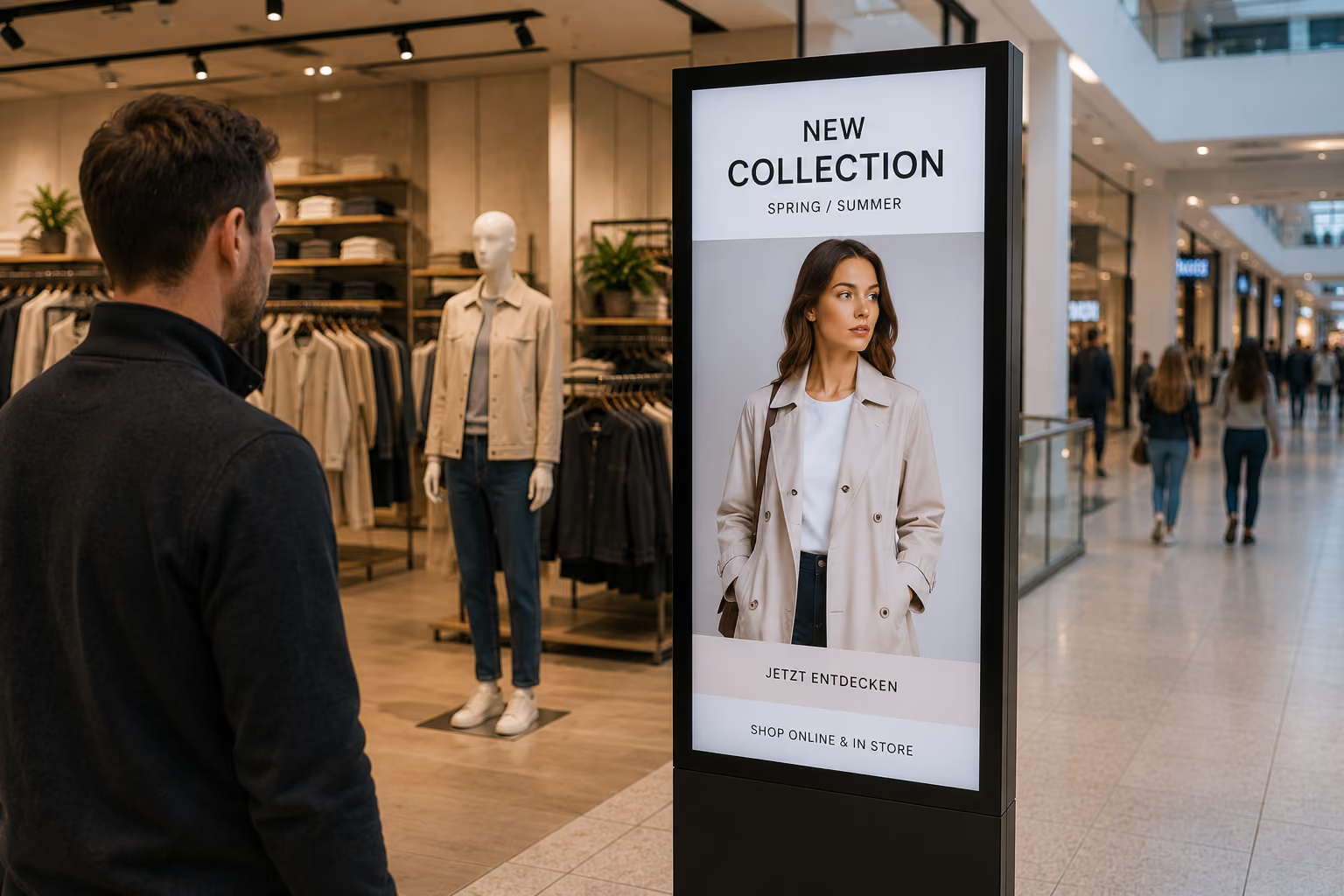
In a nutshell: An advertising display is a digital screen that plays ads, promotions, product campaigns, brand messages, or seasonal content directly at the point of sale. With connectSignage, companies can centrally manage advertising displays, schedule content, roll it out across multiple branches, and target it by location, product range, region, or campaign.
An advertising display does more than just replace a poster. It makes advertising more current, flexible, eye-catching, and manageable—right at the decisive moment of purchase.
Why traditional retail advertising reaches its limits
Many brick-and-mortar retailers still rely on printed posters, standees, or static advertising spaces. These formats have one major drawback: they lack flexibility.
As soon as prices, promotions, products, or campaigns change, print files must be updated, materials produced, and advertising media replaced on-site. This consumes time, budget, and personnel resources. The effort adds up quickly, especially when managing multiple branches.
Typical challenges with traditional advertising spaces include:
- Campaigns can only be changed with significant lead time.
- Promotions cannot be updated in real time.
- Different branches require different content.
- Local price differences are difficult to reflect.
- Seasonal campaigns must be swapped out manually.
- Moving content and videos are not possible with print.
- Brand messages are less attention-grabbing.
- Branch teams have to replace promotional materials on-site.
- Errors in pricing or promotional communication are more likely.
- Large branch networks are difficult to manage consistently using print.
An advertising display solves these problems because content can be deployed digitally, centrally, and quickly.
Why advertising displays are becoming increasingly important
Advertising displays are becoming increasingly important because purchasing decisions in brick-and-mortar retail are often influenced directly at the point of sale. Customers see a product, compare alternatives, notice promotions, and often only decide what to buy once they are in the store.
At that exact moment, attention is crucial.
Comparing them with static signage shows why digital advertising spaces at the POS can be so powerful. Dynamic digital signage can generate significantly more visual contacts than static signs. Many industry statistics describe this effect as up to 400 percent more views compared to static signage.
This means: An advertising display doesn't just stand out because it lights up. It is more effective because it uses movement, changing motifs, current content, and visual stimuli. While a static poster can fade into the background after a short time, a digital display constantly generates new attention.
The impact on purchasing decisions is also measurable. A large-scale field study on in-store digital signage analyzed 237 campaigns with around 30 million shoppers. The result: digital advertising displays increased the purchase probability for advertised products by an average of 8.1 percent.
The effect was particularly strong when products were presented emotionally, when they were popular brands or new products, and when the advertising display was placed near the advertised product.
For retailers, this means: an advertising display is not just a digital poster. It can actively influence which products are noticed, remembered, and purchased.
Compared to a static advertising poster, a digital advertising display has several advantages. Content can be moved, animated, and presented more emotionally. Campaigns can be changed at short notice. Promotions can be played based on time of day, day of the week, season, or location. At the same time, multiple motifs can rotate on the same surface without the need to print new posters or replace them on-site.
This is particularly important when product ranges, prices, or promotions change frequently. While a static poster remains unchanged after printing, an advertising display can be continuously adjusted.
Large branch networks in particular benefit from this. Eat Happy, for example, has to supply over 1,800 locations with relevant POS content. At the same time, the company offers over 150 dishes and opens more than 20 new locations per month. In such an environment, classic, manual advertising deployment would hardly be efficient.
With digital advertising displays, content can be planned centrally and yet deployed with location-specific precision — for example, by region, retail partner, product range, or branch type.
An advertising display is therefore a controllable communication channel for sales promotion, brand presence, and POS communication. It combines the attention-grabbing power of digital moving-image communication with the flexibility of centralized campaign management.
Who is an advertising display suitable for?
Advertising displays are suitable for all companies that want to make products, promotions, or brand messages visible where customers make purchasing decisions.
They are particularly useful for:
- Retail
- Chain stores
- Shop-in-shop concepts
- Supermarkets
- Grocery retail
- Fashion retail
- Electronics retail
- Furniture retail
- Drugstores
- Pharmacies
- Bakeries
- Fresh food counters
- Convenience stores
- Shopping centers
- Showrooms
- Specialty retail
- Counter-service catering
- Pop-up stores
- In-store brand spaces
Advertising displays are particularly effective wherever products need to be promoted, campaigns communicated, or brands brought to life emotionally.
What are the benefits of an advertising display?
An advertising display improves visibility, campaign management, and sales promotion at the POS.
The key benefits are:
- Products and promotions are presented in an attention-grabbing way.
- Advertising appears exactly where purchasing decisions are made.
- Campaigns can be managed centrally.
- Content can be deployed based on location.
- Promotions can be scheduled by time of day, day of the week, or season.
- Videos and animations increase visual impact.
- Branches can be managed uniformly or individually.
- New products and innovations become visible faster.
- Cross-selling and upselling potential is supported.
- Printing costs and manual replacement are reduced.
An advertising display is therefore more than just advertising on a screen. It is an active sales and communication tool at the point of sale.
What is the effect of an advertising display compared to a static poster?
A static poster can generate attention, but it is always limited to one design, one time period, and one message. As soon as a promotion, price, product, or campaign changes, the poster must be redesigned, printed, distributed, and replaced.
An advertising display is significantly more flexible—and, above all, more attention-grabbing.
The difference is particularly evident in five areas:
1. More visual contacts
Digital displays can generate significantly more attention than static signs. Dynamic content, changing visuals, and movement ensure that an advertising display is noticed more in the sales area than a stationary poster.
2. More movement in the field of vision
People react more strongly to movement than to static stimuli. Animations, videos, changing motifs, or subtle transitions ensure that an advertising display is less likely to be overlooked in a visual environment than printed advertising.
3. Greater impact at the POS
Digital advertising displays can measurably increase the likelihood of purchasing advertised products. The effect is particularly strong when the display, product, and moment of purchase align—for example, through placement near the product, an emotional motif, or the appropriate time of day.
4. More relevance through timing
A static poster shows the same content to every customer. An advertising display can adapt content based on the time of day, day of the week, season, weather, location, product range, or campaign. This makes advertising more relevant to the moment.
5. Less manual effort
Printed advertising must be produced, distributed, hung up, and replaced. An advertising display can be updated centrally. This reduces printing costs, replacement processes, and the risk of outdated motifs or incorrect promotions remaining visible.
An advertising display therefore does more than just visually replace static posters. It changes the way advertising is managed at the POS: faster, more visible, more relevant, and more scalable.
Advertising displays at the point of sale: Attention at the right moment
The most important advantage of an advertising display lies in the right moment. Advertising is particularly effective when it becomes visible exactly where customers are making their decisions.
This can be at the entrance, on the sales floor, at a brand island, in front of a promotional area, in a waiting area, or right near the checkout.
Typical content for an advertising display includes:
- current promotions
- new arrivals
- product campaigns
- seasonal highlights
- brand messaging
- cross-selling offers
- clearance sales
- Discount campaigns
- Image videos
- Product videos
- Availability
- Bundle offers
- Event or promotional notices
- Information on product benefits
Unlike static advertising spaces, an advertising display can show multiple pieces of content in rotation, extracting significantly more communication space from a single position.
Trigger purchase impulses with dynamic content
Dynamic content generates more attention than static print advertising. An advertising display can show images, animations, videos, or dynamic layouts, presenting products in a more emotional way.
This is a significant advantage, especially for impulse-driven purchases.
Examples:
- a video about the new collection in fashion retail
- an animated offer for accessories in electronics retail
- a product showcase for seasonal specials
- Brand communication in large retail spaces
- an eye-catching promotional visual at a promotion area
- a product video right next to the advertised item
- a changing promotional visual in the checkout area
Dynamic content does more than just increase visibility. It also conveys more information than a static poster—such as benefits, usage, mood, or brand identity.
Display campaigns by time of day, day, or season
An advertising display is most effective when its content isn't static. With scheduling, campaigns can be specifically run by time of day, day, or season.
Typical examples include:
- different content in the morning than in the afternoon
- Weekend promotions only on Fridays and Saturdays
- Christmas campaigns only in December
- Back-to-school promotions during the relevant period
- weather-dependent content
- Seasonal assortment changes
- Lunchtime or evening promotions
- Flash Sales at specified time slots
- Campaigns tailored to peak traffic times
This makes advertising more relevant. Customers don't see just any content, but precisely what's relevant to the current moment.
Centrally manage multi-location campaigns
When companies operate multiple locations, campaign management becomes complex. Content often needs to be visible simultaneously in many branches, but sometimes also adapted to regional requirements.
An advertising display offers enormous advantages here. Content can be managed via a central platform — either for all branches simultaneously or specifically for certain groups.
Examples:
- Campaign only for branches in Southern Germany
- Special promotion only for specific retail partners
- different prices depending on location
- specific products only in stores with relevant assortment
- consistent brand message across the entire store network
- local event promotion in individual markets
- regional assortments per market
- different campaigns by store type
This way, an advertising display combines central brand control with local relevance.
Location-specific advertising instead of a one-size-fits-all campaign
Not every store needs the same advertising. Especially in retail, assortments, prices, target groups, retail partners, and regional campaigns often differ significantly.
An advertising display can visibly reflect these differences.
One market features a sushi promotion. Another market advertises a different assortment. One store runs a regional campaign, while another highlights a seasonal product.
This is particularly important for companies with many locations or shop-in-shop concepts. In such cases, advertising must be centrally planned but cannot be identical everywhere.
With connectSignage, content can be displayed according to location profiles. These include, for example, region, assortment, retail partner, store type, or campaign affiliation.
This ensures that each display receives exactly the content relevant to its specific location.
Video walls and large advertising spaces for powerful brand presentation
Advertising displays don't always have to be small. Especially in large sales areas, entrance halls, or promotional spaces, video walls can have a particularly strong impact.
They are suitable for:
- Store staging
- New product launches
- seasonal brand worlds
- large-scale campaigns
- Window display promotions
- Event communication
- Brand presentations in showrooms
- Emotional brand content
A video wall transforms digital advertising into a spatial experience. Especially in retail, this can help capture attention and make brand worlds more tangible.
Case study: Eat Happy digitizes advertising and POS communication at over 1,800 locations
The Eat Happy case study demonstrates the powerful impact advertising displays can have across a branch network.
With its shop-in-shop concept, Eat Happy operates in over 1,800 markets in Germany and other locations across Europe. At the same time, the company offers over 150 dishes — from fresh sushi to modern Asian snacks. For POS communication, this means: Each location requires the right content at the right time, in the right design, and tailored to its specific product range.
The rollout is also highly dynamic: More than 20 new locations are opened each month. Displays must therefore be quickly integrated and provided with suitable content without manual effort.
To address this, a central digital signage platform was implemented using connectSignage. Content is automatically delivered based on location profiles such as region, retail partner, or product range. Each display receives exactly the content relevant to its specific market. New devices are automatically recognized via their serial number, assigned to the appropriate location, and immediately provided with the correct content — without on-site manual configuration.
The result is scalable, efficient POS communication across the entire branch network. Price, promotional, and advertising content is delivered precisely for each location, new displays are automatically integrated, and operational complexity is significantly reduced.
View the case study: Eat Happy digitizes over 1,800 locations in Europe
Advertising displays for brand messaging and sales
An advertising display can serve various purposes. Some content is more image-focused, while other content is sales-oriented.
Typical goals include:
- Increase brand awareness
- Highlight new products
- Communicate promotions
- Boost add-on sales
- Drive impulse purchases
- Optimize dwell time
- Accelerate sales
- Enhance the emotional appeal of product categories
- Improve retail space presentation
- Support the in-store customer journey
Depending on the objective, the advertising display can be designed in various ways: emotional, informative, engaging, or sales-boosting.
Typical locations for advertising displays
Advertising displays can be used in many areas of brick-and-mortar retail. The key question is always: Where are purchasing decisions made, or where can attention be best captured?
Typical locations include:
- Entrance area
- Shop window
- Sales floor
- Promotional area
- Brand island
- Near-shelf area
- Fresh food counter
- Shop-in-shop area
- Checkout area
- Waiting area
- Promotional stand
- Showroom
- Mall space
- Service area
- Pick-up area
Content varies depending on the location. Window displays are often about grabbing attention and driving foot traffic. On the sales floor, the focus is on products and promotions. In the checkout area, it is more about impulse buys and last-minute offers.
Technical requirements for businesses
For advertising displays to function reliably in everyday operations, you need central software that efficiently connects campaigns, locations, and content.
Key technical requirements include:
- centralized control of all advertising displays
- simple campaign planning
- scheduling by time of day, day of the week, or season
- location-based content delivery
- branch groups and location logic
- flexible layouts
- support for videos and animations
- video wall functionality
- simple media management
- roles and permissions for marketing, sales, and branch management
- automatic assignment of new displays
- monitoring for displays and players
- reliable playback even in retail environments
- flexible hardware support
- integration with data sources or existing systems
With connectSignage, companies can manage advertising displays via a central platform and deploy content to individual stores, regions, or retail groups.
Why connectSignage is ideal for advertising displays
connectSignage is digital signage software for the centralized control of digital displays. It is particularly well-suited for advertising displays because it easily combines campaigns, location logic, and POS communication.
The key benefits are:
- centralized control of all advertising displays
- cross-branch campaign deployment
- location-specific content based on region, product range, or retail partner
- scheduling for promotions and seasonal campaigns
- flexible layouts and media formats
- support for videos, animations, and video walls
- easy management via browser
- automatic integration of new displays
- reduced operational complexity for large retail networks
- roles and permissions for marketing and store teams
- monitoring for reliable operation
- Scalable infrastructure for growing location networks
This is how an advertising display becomes a controllable sales channel — from a single store to a Europe-wide branch network.
Conclusion: Advertising displays make POS communication more visible and effective
Advertising displays help companies make products, promotions, and brand messages visible exactly where purchasing decisions are made.
Compared to static posters, they offer significantly more flexibility: content can be animated, updated, scheduled, and displayed based on location. This makes advertising at the point of sale not only more eye-catching but also more relevant.
They are particularly effective where products need to be showcased emotionally, promotions need to be changed at short notice, or branch networks need to be managed centrally.
With connectSignage, companies can centrally manage advertising displays, plan campaigns, deploy content by location, and efficiently integrate new displays into existing structures.
This turns an advertising space into a scalable communication channel for sales promotion, brand impact, and POS communication.
Frequently asked questions about advertising displays
1. What is an advertising display?
An advertising display is a digital screen that shows advertisements, promotions, product campaigns, or brand messages directly at the point of sale. It is used to generate attention and trigger purchasing impulses.
2. What are advertising displays suitable for?
An advertising display is suitable for product advertising, promotional communication, brand staging, cross-selling, seasonal campaigns, upselling, and POS communication in brick-and-mortar retail.
3. Where are advertising displays used?
Advertising displays are used in entrance areas, shop windows, on the sales floor, at promotional areas, in checkout zones, at counters, on brand displays, or in showrooms.
4. Why are advertising displays useful in retail?
Advertising displays are useful in retail because they make products and promotions visible exactly where purchasing decisions are made. They increase attention and can be controlled centrally and flexibly.
5. What is the advantage over a static advertising poster?
An advertising display is more flexible, up-to-date, and attention-grabbing than a static poster. Content can be animated, changed, scheduled, and displayed based on location without the need to print or replace physical posters.
6. Do advertising displays generate more attention than static signs?
Yes. Dynamic digital signage can generate significantly more visual contacts than static signage because movement, changing motifs, and visual stimuli stand out more in a retail environment.
7. Can advertising displays influence purchasing decisions?
Yes. Studies on in-store digital signage show that digital advertising displays can increase the likelihood of purchasing advertised products, especially when they are placed near the product and the message is relevant to the moment of purchase.
8. Can advertising displays play content on a schedule?
Yes. Advertising displays can automatically change content based on the time of day, day of the week, season, or campaign period. This allows promotions and advertising messages to be planned precisely.
9. Can content be managed across multiple branches?
Yes. With connectSignage, content for individual branches, groups of branches, regions, or the entire network of locations can be managed centrally while still being adapted locally.
10. Can advertising displays show videos?
Yes. Advertising displays can play images, animations, videos, and dynamic content. This makes products and brand messages much more attention-grabbing than static print media.
11. Can advertising displays be used for large branch networks?
Yes. Large branch networks in particular benefit from advertising displays because content can be played automatically and based on location. This reduces manual effort and increases consistency across all branches.
12. Is there a practical example of advertising displays in a branch network?
Yes. Eat Happy uses connectSignage to display price, promotional, and advertising content across more than 1,800 locations in Europe with location-specific accuracy and to automatically integrate new displays.
13. Can advertising displays also be used for video walls?
Yes. Advertising displays can also be used as large-format video walls to showcase brand worlds, campaigns, or products on retail floors with high visual impact.
14. How does connectSignage support advertising displays?
connectSignage helps companies centrally manage advertising displays, schedule campaign playback, efficiently supply content to branches, and display information based on location.
Bereit für einfaches und leistungsstarkes Digital Signage?
Erlebe connectSignage live und entdecke, wie du digitale Displays, Inhalte und Standorte zentral steuerst und Digital Signage für deine Unternehmenskommunikation einsetzt.
Weitere Insights rund um Digital Signage
Entdecke weitere Artikel zu Digital Signage, interner Kommunikation, Integrationen und konkreten Anwendungsfällen.