.png)
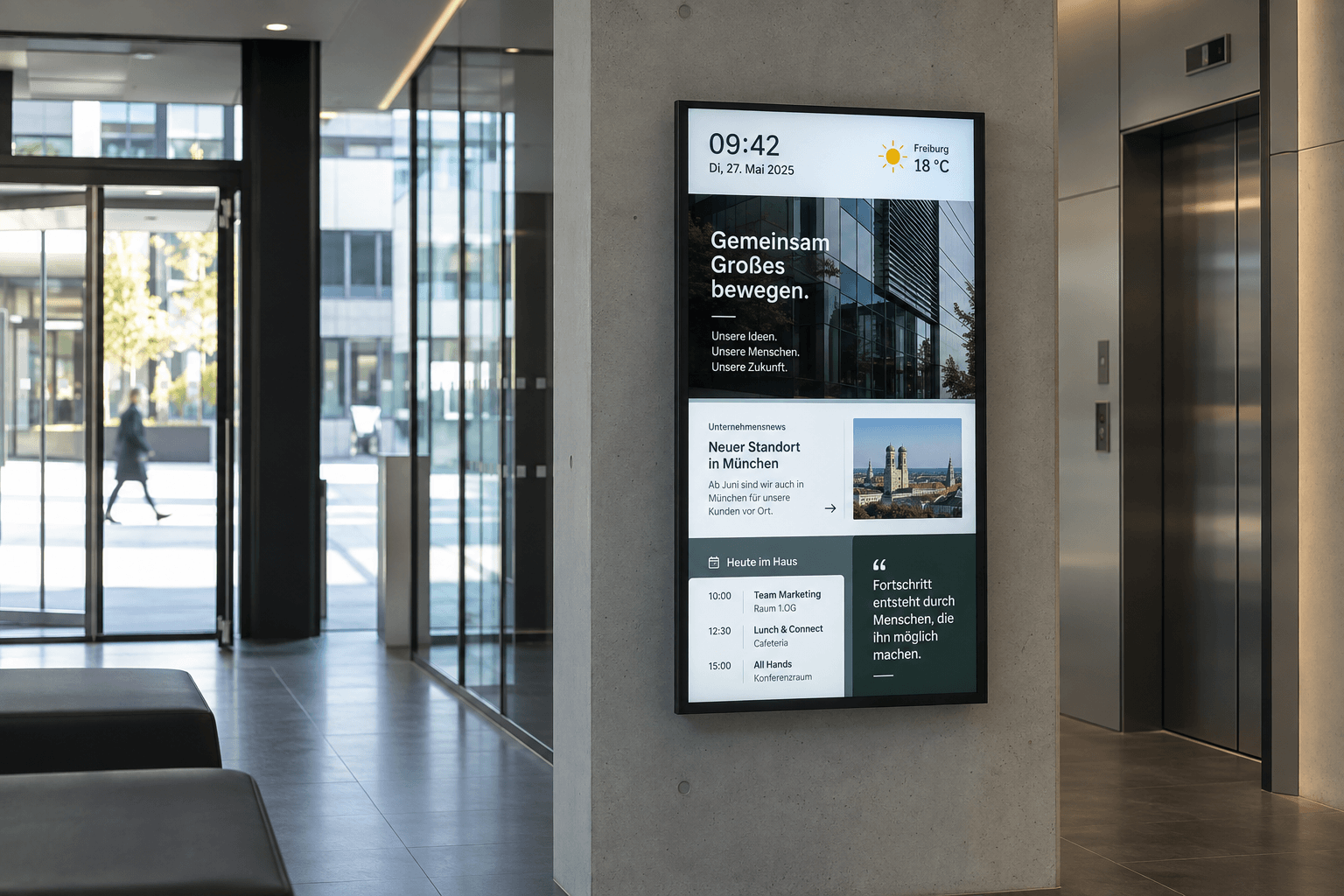
Digital screens have long been established as a crucial communication channel in companies. Whether corporate news, safety information, job postings, or current key figures – relevant information needs to quickly reach employees where they work.
In practice, however, this often fails due to one problem: Content management is too complicated.
If every change has to go through the IT department, external service providers, or central administrators, delays occur. Content is not updated in time, and system acceptance decreases.
Modern digital signage solutions therefore rely on a different approach: No-code content management for departments.
What does no-code mean in digital signage?
No-code means that content can be created, edited, and published without technical knowledge.
Marketing, HR, corporate communications, or individual locations can manage information independently without relying on IT resources.
The advantages are clear:
- Faster content updates
- Higher relevance of displayed information
- Less coordination effort
- Relief for the IT department
- Greater acceptance among departments
Especially for cross-location communication, ease of use becomes a decisive success factor.
Why traditional approval processes often become a bottleneck
Many companies start digital signage projects with a centralized publishing model.
This initially sounds sensible: One person or department manages all content and ensures a consistent appearance.
However, as usage grows, challenges arise:
- HR needs to communicate job openings quickly.
- Production requires up-to-date safety information.
- Marketing plans time-sensitive campaigns.
- Branches want to publish local content.
If every change must be routed through a central point, this results in delays and unnecessary process costs.
The result: screens display outdated content or are barely used by the departments.
The requirements for modern digital signage software
For departments to manage content independently, a simple content editor is insufficient.
Modern platforms require a balance of user-friendliness and governance.
Intuitive Operation
Employees should be able to create content without training or technical knowledge.
Drag-and-drop editors, straightforward media management, and clear user interfaces significantly lower the barrier to entry.
Role and Permission Concepts
Not every user needs access to all content.
For example, a modern digital signage system enables:
- Location-specific permissions
- Department-specific approvals
- Centralized template management
- Controlled publishing processes
This maintains communication quality while allowing departments to work flexibly.
Template-based content management
Templates are among the most important features of modern digital signage solutions.
They enable departments to edit content independently without altering the corporate design.
Logos, colors, and layouts remain protected, while texts, images, or videos can be flexibly adjusted.
Integration of existing systems
Companies already use numerous systems for providing information.
These include:
- Microsoft 365
- SharePoint
- Power BI
- ERP systems
- Social media channels
A modern digital signage platform should be able to automatically integrate this information to avoid duplicate maintenance efforts.
No-code strengthens internal communication
Especially in the area of internal communication, the value of no-code solutions is evident.
Information can be published directly by the responsible departments. This shortens communication channels and ensures important content reaches employees faster.
This is particularly relevant in companies where not all employees regularly have access to emails or the intranet.
Digital displays create additional visibility for information and ensure that messages appear where they are actually noticed.
Why Companies Opt for Decentralized Content Management
The demands on corporate communication are continuously increasing.
Employees expect up-to-date information. Departments need flexible tools. At the same time, corporate design and compliance guidelines must be adhered to.
No-code content management combines these requirements:
- Departments gain independence.
- IT is relieved.
- Content is published faster.
- Corporate standards are maintained.
This transforms digital signage from a mere information system into an active communication platform.
Conclusion
The success of a digital signage project does not depend solely on the screens or the software.
What's crucial is how easily content can be managed.
Companies that empower departments to manage content independently benefit from faster processes, up-to-date communication, and greater acceptance throughout the organization.
No-code content management is therefore not an additional feature, but a central prerequisite for successful digital corporate communication.
Bereit für einfaches und leistungsstarkes Digital Signage?
Erlebe connectSignage live und entdecke, wie du digitale Displays, Inhalte und Standorte zentral steuerst und Digital Signage für deine Unternehmenskommunikation einsetzt.
Weitere Insights rund um Digital Signage
Entdecke weitere Artikel zu Digital Signage, interner Kommunikation, Integrationen und konkreten Anwendungsfällen.
.png)

.png)
.png)
.png)
.png)
.png)
.png)